01 / METHOD
A controlled representation study
Source expressions are compiled with the authoritative official_v4 formulas into pure EML trees. Exact sharing and verifier-gated transformations create representation channels; bounded learning tests then measure what topology buys and what it costs. The representation is intentionally austere so that a result can be attributed to structure rather than a growing operator vocabulary.
SourceAST expressions with domain and family metadata
Compileofficial-v4 pure EML tree, canonical and auditable
Shareexact DAG construction by hash-consing
Compresse-graph, frequent motif, and learned motif channels
Testbounded GNN, rewrite, proof, and regression tracks
The AST-DAG channel is the fairness baseline. It separates the effect of graph sharing from the effect of the EML abstraction itself.
02 / CORPUS
Goals 1–5: corpus, compression, and exact costs
Goal 1 · source corpus complete
Exactly 250,000 unique source expressions were accepted from 286,413 attempts with no unsupported rows and no cross-split identity collisions.
- Splits: 175,000 / 25,000 / 25,000 / 25,000 train, validation, test-IID, test-OOD.
- Six families and 1–6 variables; trig and hyperbolic operators are present under their approved domains.
- Authoritative s-expressions, expression IDs, and structural identities are each unique at 250,000.
Goal 2 · official-v4 expansion complete
Official-v4 compilation succeeded for all 250,000 / 250,000 rows. The semantic audit is a selected subset, not a conversion-failure count.
- Selected 280; materialized 273: 203 passed, 3 mismatched, 45 nonfinite, 22 overflow, and 7 exceeded the node limit before materialization.
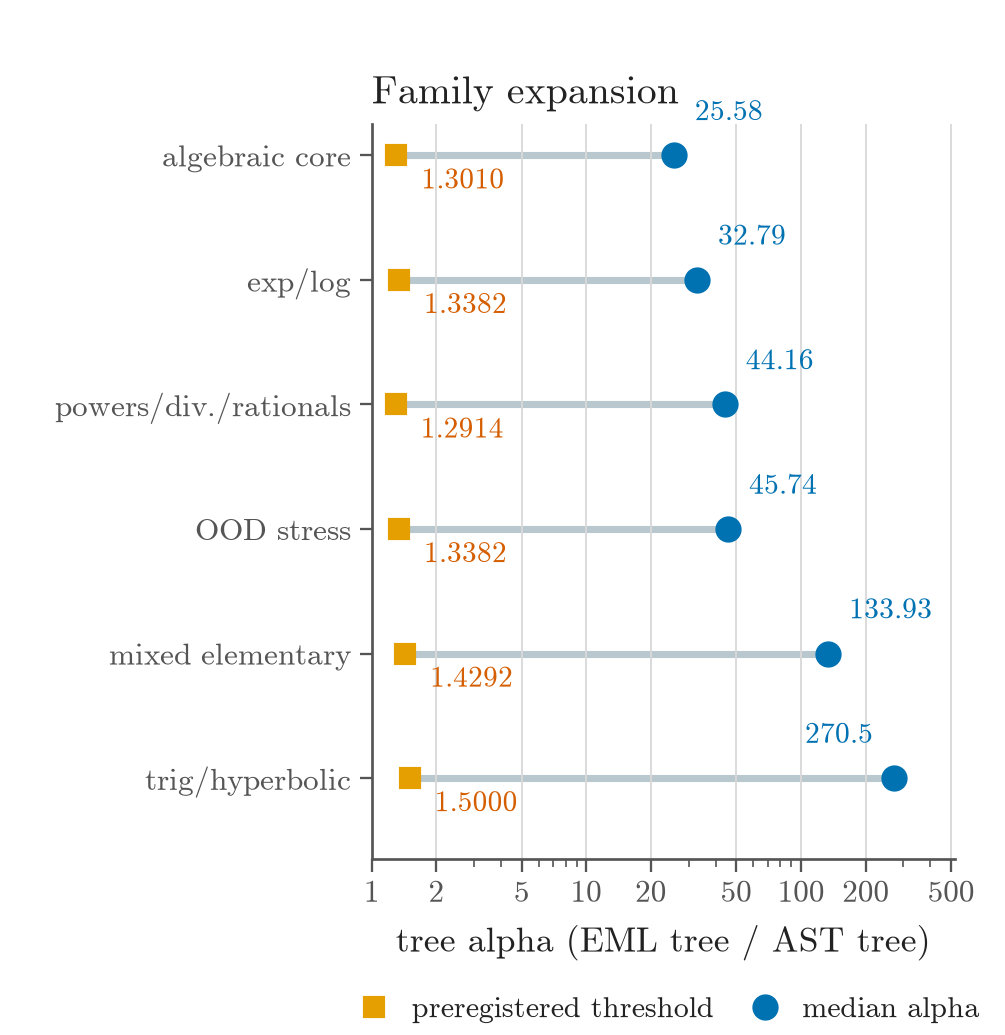
- Raw α: median 40.6602, mean 952.1371, approximate p99 10,448.6.
- Zero rows fall below the preregistered 1.29–1.50 threshold range.
Goal 3 · exact DAGs complete
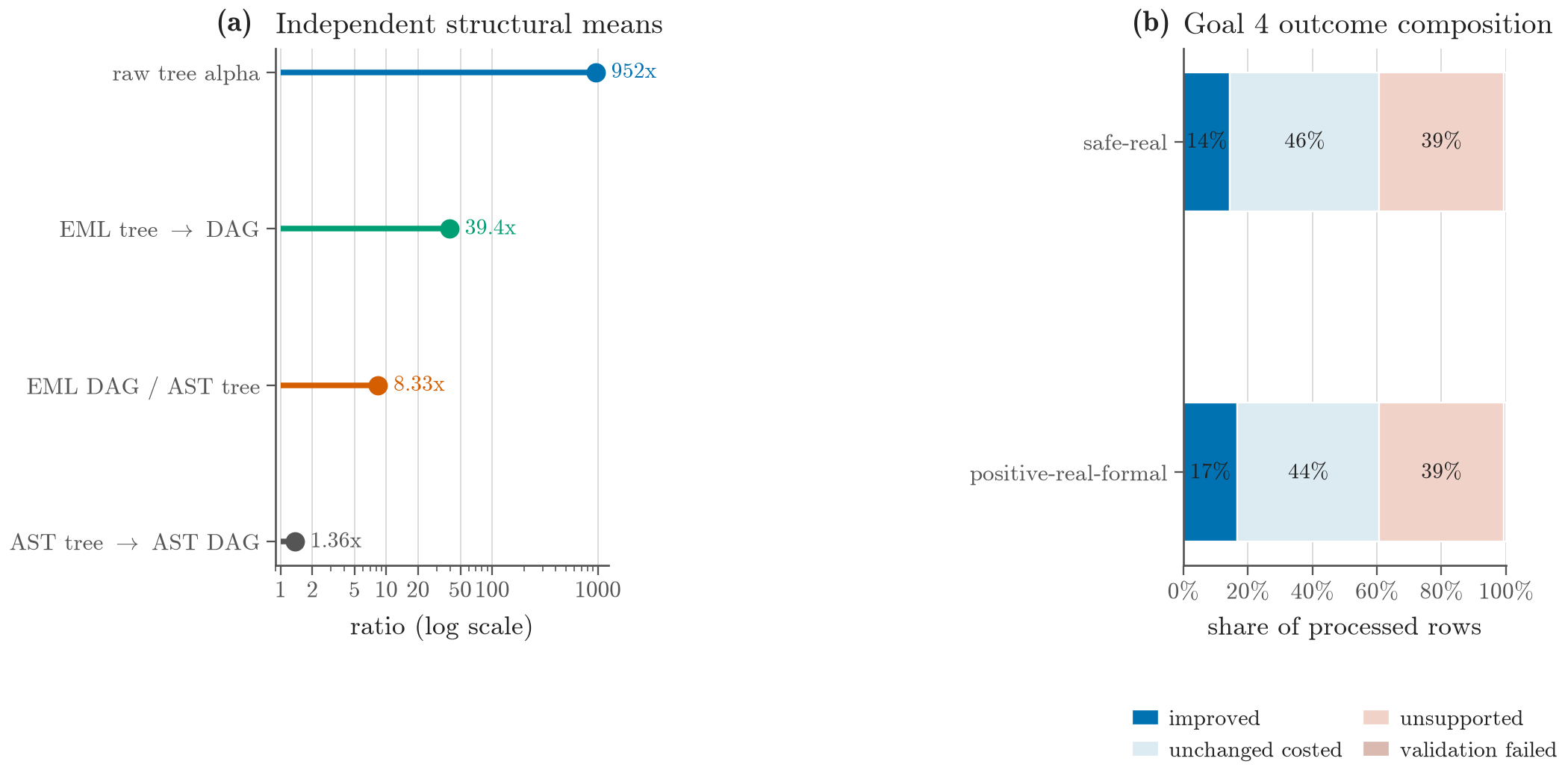
Both AST-DAG and EML-DAG were built for all 250,000 / 250,000 rows. Exact EML sharing recovers 39.375× of the raw EML tree on mean node count.
- Mean EML-DAG / AST-tree ratio: 8.3344; EML-DAG / AST-DAG: 10.4750.
- No row is structurally competitive with the AST baseline; the best remaining ratio is 8/7.
Goal 4 · verifier-gated e-graphs complete
Each mode processed 30,000 rows. Exactly 18,210 were costed; 11,790 were retained as unsupported or independently invalid, with no timeouts.
- safe_real: 4,349 improvements, 23.8825% of costed rows.
- positive_real_formal: 5,026 improvements, 27.6002% of costed rows.
- Failures are principally unsupported trig/hyperbolic operators or validation rejection, not hidden zeros.
Goal 5 · motifs and learned baselines complete
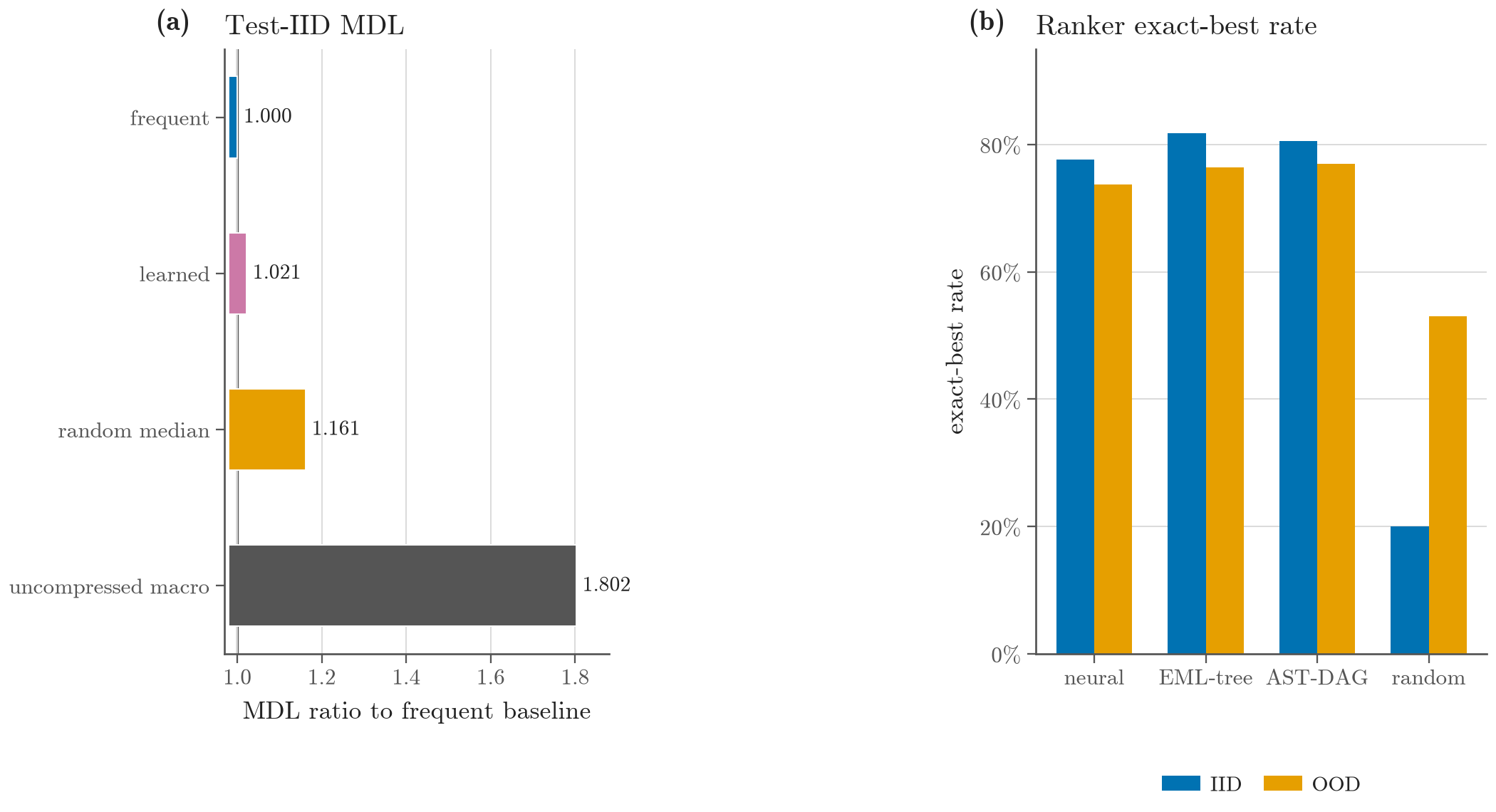
The frequent motif dictionary is the strongest simple lossless channel: 44.5127% IID and 43.6983% OOD MDL savings with zero reconstruction failures.
- Learned motifs lose to equal-budget frequent motifs (IID: 324.5M vs 317.7M bits).
- The neural ranker is faster, but loses exact-best selection: 8,349/10,752 IID groups versus 8,796 for the EML-tree heuristic and 8,661 for AST-DAG.
- Production export covers 250,000 expressions, 1,250,000 graph views, 250,000 hierarchies, and 2,500 batches with zero validation or reconstruction failures.
- These are retained null comparisons, not silently omitted wins.
03 / PHASE B
Authenticated GPU evidence, with boundaries
The archived Phase-B package is operationally authenticated, but operational completion is not the same as a completed scientific gate. The table below reports only the cells and metrics present in the ledger.
Goal 6 · equivalence source refresh
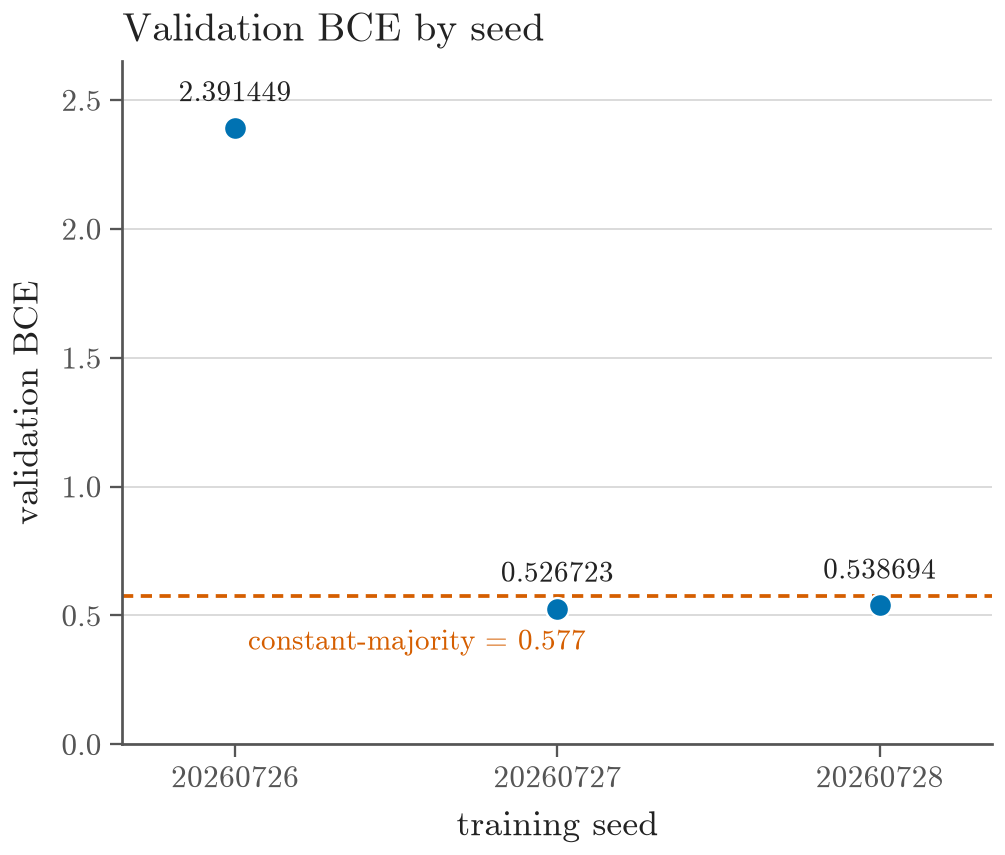
partial · source refresh only Three current-source pure-EML cells were run with seeds 20260726–20260728. They do not constitute the planned six-arm, three-seed (18-cell) Goal 6 verdict; the measured result is a pure-EML viability signal, not a general learning verdict.
Reviewer shorthand: pure-EML viability signal — 2/3 source-refresh seeds below the pilot majority floor; controlled six-arm comparison unrun.
| Seed | Validation BCE | Wall time | Below pilot 0.577 reference? |
|---|
| 20260726 | 2.391449 | 2883.6 s | no |
| 20260727 | 0.526723 | 2890.9 s | yes |
| 20260728 | 0.538694 | 2888.9 s | yes |
Goal 7 · rewrite-step prediction
partial · invalids retained The logical denominator is 18 cells: 13 complete + 5 invalid. The invalid cells remain in the denominator. A separate retrieval auxiliary grid completed 15 / 15 operational cells; this is operational completeness only, not a retrieval-quality verdict and not a substitute for the incomplete scheduler.
Goal 8 · value-head diagnostics
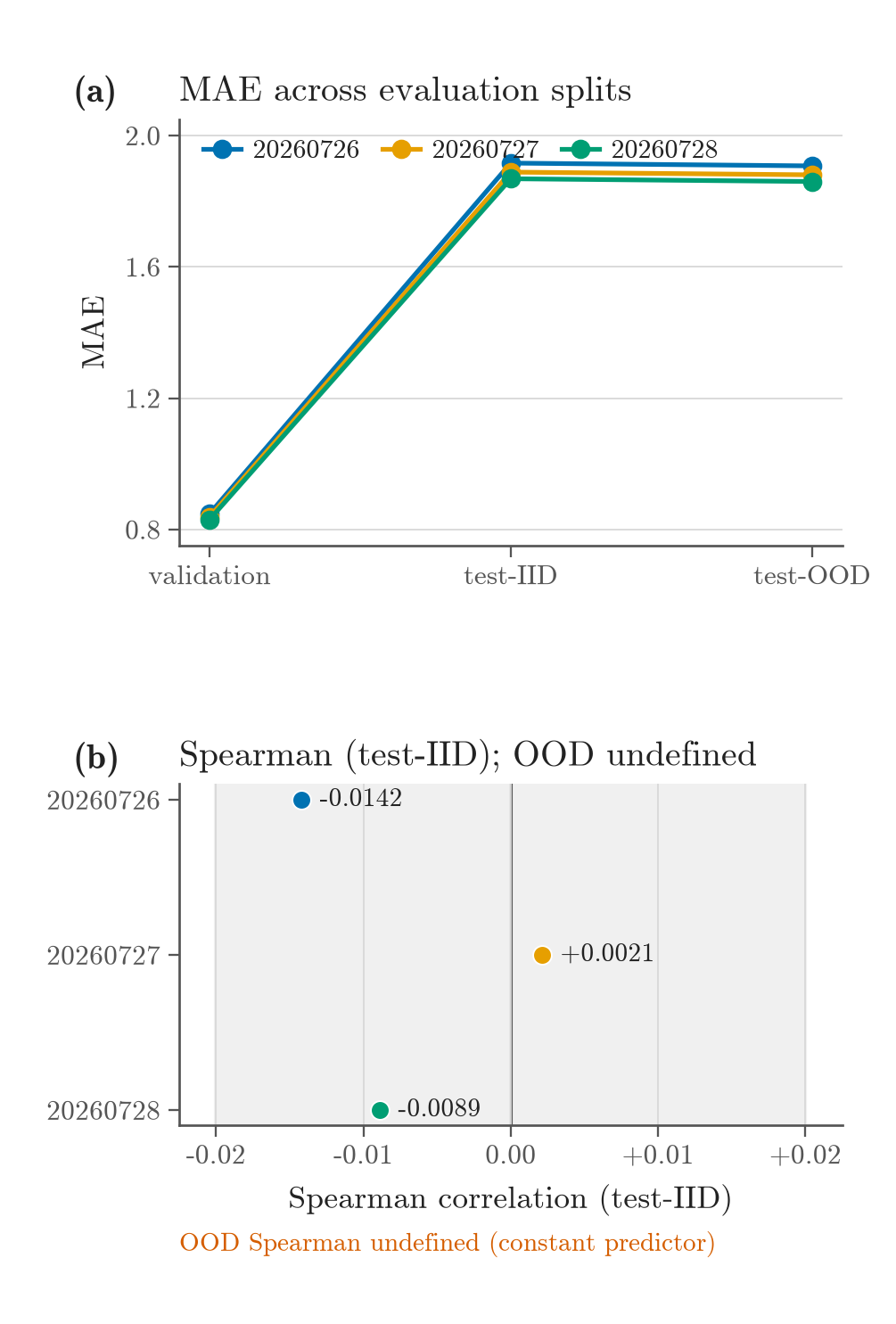
retained null / collapsed Three runs completed with 1,500 optimizer steps and 452,820 trainable parameters. Validation MAE ranges from 0.8296–0.8472, but held-out ranking is at chance and OOD Spearman is undefined; the value head must not be presented as a useful ranker.
| Seed | Validation MAE | IID Spearman | OOD Spearman |
|---|
| 20260726 | 0.8472 | −0.0142 | undefined |
| 20260727 | 0.8376 | +0.0021 | undefined |
| 20260728 | 0.8296 | −0.0089 | undefined |
04 / LEDGER
Goal 1–12 status matrix
Statuses describe authenticated evidence, not optimism about an implementation path. “Unavailable / unrun” is distinct from zero, and “partial” is distinct from complete.
completepartialretained nullbounded gate failunavailable / unrun
| Goal | Status | Evidence-safe interpretation |
|---|
| 1 | complete | 250,000 unique source rows; all planned splits and corpus QA are authenticated. |
| 2 | complete | 250,000 / 250,000 official-v4 compilations; selected semantic audit caveats retained. |
| 3 | complete | Exact AST-DAG and EML-DAG corpus build; no structurally competitive EML row. |
| 4 | complete | Two 30k mode runs; improvements reported over costed denominators. |
| 5 | complete | Frequent motif wins simple lossless comparison; learned channels retain null results. |
| 6 | partial | Three-cell current-source refresh only; not the six-arm Goal 6 verdict. |
| 7 | partial | 13 complete + 5 invalid of 18 logical cells; retrieval 15/15 is separate. |
| 8 | retained null | Three completed value runs; collapsed ranking signal and undefined OOD Spearman. |
| 9 | unavailable / unrun | No authenticated production symbolic-regression comparison. |
| 10 | bounded gate fail | 74-row CPU compiler gate retained; eight asin/acos endpoint cells fail the bounded endpoint evaluation. Broader production was not authenticated. |
| 11 | unavailable / unrun | No authenticated scale-up or external-LLM benchmark ledger. |
| 12 | unavailable / unrun | No authenticated final-consolidation or release gate. |
05 / REPRODUCE
Evidence, provenance, and limits
Every headline number on this page is copied from the compact, machine-readable results ledgers or the linked goal summaries. The JSON copies are page-local so the public page remains self-contained when deployed from the docs/ source directory.
What is not shippedLarge raw corpora, checkpoints, GPU logs, and archives are excluded from this anonymous page release. Their absence is not a claim that the associated gate is complete.
No missing value is imputed. Checksums and artifact authentication are documented in the linked provenance and validation records. GPU bitwise reproducibility across hardware is not claimed; retained cuBLAS warnings remain part of the evidence record.
Limitations and non-claims
- Raw EML expansion is a measured cost, not a claim that EML is storage-efficient without sharing.
- Exact DAG recovery does not make EML-DAG smaller than the AST baseline.
- Goal 4 percentages use the costed denominator; unsupported and validation-rejected rows remain visible.
- Goal 7 invalid cells remain in the 18-cell denominator.
- The Goal 8 value head is a retained null/collapsed result, not a successful proof-search guide.
- The Goal 10 result is a bounded CPU gate failure, not a corpus regeneration or full trig-domain verdict.
- Goals 9, 11, and 12 have no authenticated production evidence in this snapshot.
- The page does not claim that the overall GEML project is complete.